Currently being updated

English is the foundation of our curriculum. It is embedded throughout our curriculum through reading, writing, speaking and listening. Our English curriculum will enable our pupils to speak and write fluently so that they can communicate their ideas and emotions to others, and through their reading and listening, enable others to communicate with them. Through reading in particular, our pupils will develop culturally, emotionally, intellectually, socially and spiritually. Reading also enables our pupils both to acquire knowledge and to build on what they already know. All the skills of language are essential to participating fully as a member of society, and we value Literacy as the key to accessing knowledge and skills in other subjects, and therefore we teach all aspects of English rigorously. We strive to ensure all pupils leave us with a good standard of reading and writing as we appreciate the lifelong opportunities this will afford them. There is a clear plan for progression. Children will be supported to close any gaps in their learning. Where children show high ability, talent and interest, they will be challenged. Every effort will be made to identify and lift barriers to learning. English will be presented as a subject to enjoy.
We aim for our children to be reading fluently by the time they leave our school so that they are motivated to read for pleasure and able to fully access all future learning opportunities.
At the heart of reading is its purpose – reading for meaning. We aim to develop pupils’ passion for literature and their intrinsic motivation to read. We aim to promote a simple view of reading where word recognition and language comprehension combine to develop effective lifelong readers. We recognise the importance of spoken language in developing comprehension and vocabulary and promote strong pupil voice within effective teaching and learning. Vocabulary development is understood to be key to reading comprehension. We use carefully selected text to develop empathy and our key Christian core values.
We are a reading school;
‘We learn to read so we can read to learn.’
Every class spends time in our recently restocked library and each child brings a library book home weekly.
All classes have a reading spine consisting of a variety of genres, authors and themes. They have access to a welcoming reading area within each room. Story time is timetabled into every class, every day.
Across the school, children are exposed to a wide variety of quality texts. We follow Literacy Tree ‘Literacy leaves’ to support the development of reading skills, developing their understanding of vocabulary in context, comprehension and fluency.
We are introducing a new phonics program; ‘Read Write Inc.’ Children begin this in Reception. It is taught daily in years R, 1 and 2 phonics, spelling, reading and writing is covered in each session.
Once children are able to decode, books matched to their ability go home for them to share with their parents and carers. As they progress through the school, RWI books are replaced with books chosen from our library, guided by teachers to ensure they are an appropriate challenge.
We expect all children to read at home, this can be their library book, school reading book and book of their own choice from home – all reading is valued, we encourage this to be recorded in children’s reading diaries which come to school daily.
A bit more about Read Write Inc.
Synthetic phonics is used when teaching early literacy skills to children. Synthetic phonics is simply the ability to convert a letter or letter group into sounds that are then blended together into a word.
We have introduced the Read Write Inc (RWI) programme which is a method of learning based upon letter sounds and phonics, we use it to support children in their reading and writing.
The children are assessed every half term and grouped according to the phonics sounds they need to learn. They will work with a RWI trained teacher or teaching assistant in these groups every day for one hour.
Reading
When using RWI to read the children will:
- Learn 44 sounds and the corresponding letter/letter groups using simple prompts
- Learn to read words using sound blending (Fred talk)
- Read stories featuring words they have learnt to sound out
- Show that they comprehend the stories by answering ‘Find It’ and ‘Prove It’
Writing
When using RWI to write the children will:
- Learn to write the letter/letter groups which represent the 44 sounds
- Learn to write words by saying the sounds and graphemes (Fred fingers)
Talking
When using RWI the children will also work in pairs:
- To answer questions
- To take turns talking and listening to each other
- To give positive praise to each other
Blending
We use a puppet called Fred who can only speak in sounds, not whole words. We call this Fred Talk. For example, Fred would say d-o-g, we would say dog. Your child is taught to hear sounds and blend them together in sequence to make a word. We start with blending oral sounds, then progress to reading the letters and blending them together to read the word.
Help your child learn to read words by sounding-blending (Fred talk) eg. c-a-t = cat, sh-o-p = shop. Children learn to read words by blending the letter-sounds that are in the Speed Sounds set.
Help your child to say the pure sounds (‘m’ not ‘muh’, ‘s’ not ‘suh’ etc.) as quickly as they can, and then blend the sounds together to say the whole word.
Reading Books Sent Home
Children in Reception who are learning the first 44 letter sounds and are not blending fluently will bring home sound sheets, picture books and a library book for you to read with them.
Once children can blend fluently and know the first 44 sounds they will bring home Ditty sheets or their current RWI book which they are reading in class, the corresponding book bag book, a corresponding non fiction book and a sharing book from the library.
Read Write Inc Books
Please encourage your child to read though the speed sounds page first, then the green and red words page and then check your child understands the meaning of words on the vocabulary check page, before they start reading the book. Your child will have read this book at least three times before they bring it home. They should be able to read this book with fluency and expression by the time they bring it home and they should have a good comprehension of what the book is about. At the back of the book are find it/prove it questions for you to do with your child.
Your child may want to read this book many times, each read can be logged in their reading diaries. Books will be changed as part of their RWI lesson, it may be that they will have the same book for several days even if it has been recorded that they have read it.
Finally, don’t worry if your child is struggling at first with their sounds and words, they will get there in their own time.
Pupils make progress in reading in line with National Curriculum expectations. There is a buzz around reading where children enjoy reading different genres and want to read and share their love for literature. Children transition to high school with key competencies in reading in line with national expectations. Children read widely, often and with fluency. Pupils are able to identify different question types and can generate literal, inferential and evaluative questions for themselves. Through reading children are supported to access the wider curriculum with increasing independence.
Our aim is that our children leave school as confident, capable and independent writers, being able to communicate their knowledge, understanding ideas and emotions through their writing. Writing standards will be in line with national expectations to support children to fully access the wider curriculum. We aim for children to not only understand the purpose and importance of writing but also to enjoy the process.
Children will be exposed to a variety of quality literature of varied genres to support their writing experiences and to have opportunities to develop their oracy skills in order to:
- develop vocabulary,
- articulate and justify answers, arguments and opinions,
- give well-structured descriptions, explanations and narratives for different purposes
- Participate in discussions, role play, debates and presentations
- Consider and evaluate viewpoints
We aim for children to be able to spell new words effectively through the use of spelling patterns and rules and have a solid understanding of punctuation and grammar, applying them effectively and consistently to their writing.
We aim for children to take pride in their writing and be able to write so others can read it, through the use of a legible, cursive handwriting style and through confident use of Information Technology.
Across the school, children receive daily English lessons. Units of work are carefully planned through the use of our progression documents, assessments and curriculum coverage charts in order to ensure high quality, exciting and relevant writing activities covering a range of genres, purposes and audiences. Our marking policy supports children in understanding their next steps to progress. Appropriate scaffolding approaches are provided to support learners, they also enjoy a variety of teaching approaches including collaborative, partner work, pupil talk, peer assessment, learning ladders in order to enable them to reflect on their progress, evaluate, make improvements and set new targets.
Regular assessed ‘Big Write’ pieces of writing are completed throughout the year in order to effectively assess and inform planning. In addition, children complete grammar, punctuation and spelling checks termly in order to monitor progress and identify gaps in learning. Children are supported through targeted interventions to lift barriers to learning and close gaps in learning. Quality first teaching ensures quality and there is a collaborative approach to moderate work between classes and year groups.
Children leave school as confident, enthusiastic writers with the skills necessary to access the next stage of learning. They have stamina to write at length and with focus. They can adapt their writing for purpose and audience. They enjoy writing and use it to develop their voice.
At Salhouse, we ensure our children receive high quality hand writing teaching so they are able to write fluently, legibly and with increased speed, eventually transitioning to joined handwriting by using Read, Write Inc. Phonics Handwriting and moving to Nelsons handwriting.
It is our intent that as they move on to high school, they are prepared for the handwriting demands.
At Salhouse, we follow the RWI programme for the early stages of taught handwriting and aim to make the physical process of writing – handwriting – enjoyable from the start, so that children can see themselves as ‘writers’. From year 2 onwards, we use Nelson’s handwriting to ensure a consistent approach to ensure our learners are continuing their writing journey.
We use the RWI mnemonics – memory pictures – to help children visualise the letter or join before they write it down. Therefore, children learn the letter formation alongside learning the sound.
We ensure that children practise handwriting under the guidance of a teacher so they do not develop habits that will be difficult to undo later. In addition to this, we place emphasis on being ‘writing ready’ by teaching the children how to adopt an appropriate writing posture. We encourage writing to take place with:
- feet flat on the floor
- bottom at the back of the chair
- body one fist from the table
- shoulders down and relaxed
- back leaning forward slightly
- left/right hand holding the page
- left/right hand ready in a tripod grip
In addition to practising writing, we recognise and value to importance of developing children’s fine and gross motor skills to enable them to have the strength required for pencil grip accuracy and posture.
We ensure that children have opportunities to target their fine motor skills with purposeful tasks in the learning environment. To support children’s gross motor development, we have a variety of active opportunities for body strengthening in the outdoor learning environment.
Read Write Inc stages of Handwriting development
There are 3 stages of handwriting using the Read Write Inc programme.
Stage 1a:
During Stage 1 children learn correct letter formation using the same picture mnemonics they have already learnt in the Set 1 sound lessons.
These letters are taught in handwriting groups:
- ‘Around’ letters: c a o d g q
- ‘Down’ letters: l t b p k h i j m n r u y
- ‘Curly’ letters: e f s
- ‘Zig-zag’ letters: v w z x.
During these early stages, children write on plain paper.
Stage 1b:
Once children can form the letters correctly, they learn how to place the letters on the line and of relative size. Children are encouraged to continue using the picture mnemonics help children to visualise the size and placement.
At this stage, children are encouraged to write on wide-lined paper.
Stage 2
During Stage 2, children are now taught that they are going to use new characters to help them develop a grown-up style of writing that will lead to joined-up writing. New pictures will help them to visualise the new shapes. They learn where to position each letter on the handwriting paper lines. We use the ‘handwriting village’ resources through Read Write Inc
Stage 3
The final handwriting stage within Read Write Inc, introduces the children to two joins:
- The arm join (diagonal)
- The washing line join (horizontal)
Both joins have three variations.
It is an expectation that no matter what the subject area being taught, children maintain their handwriting style and presentation.
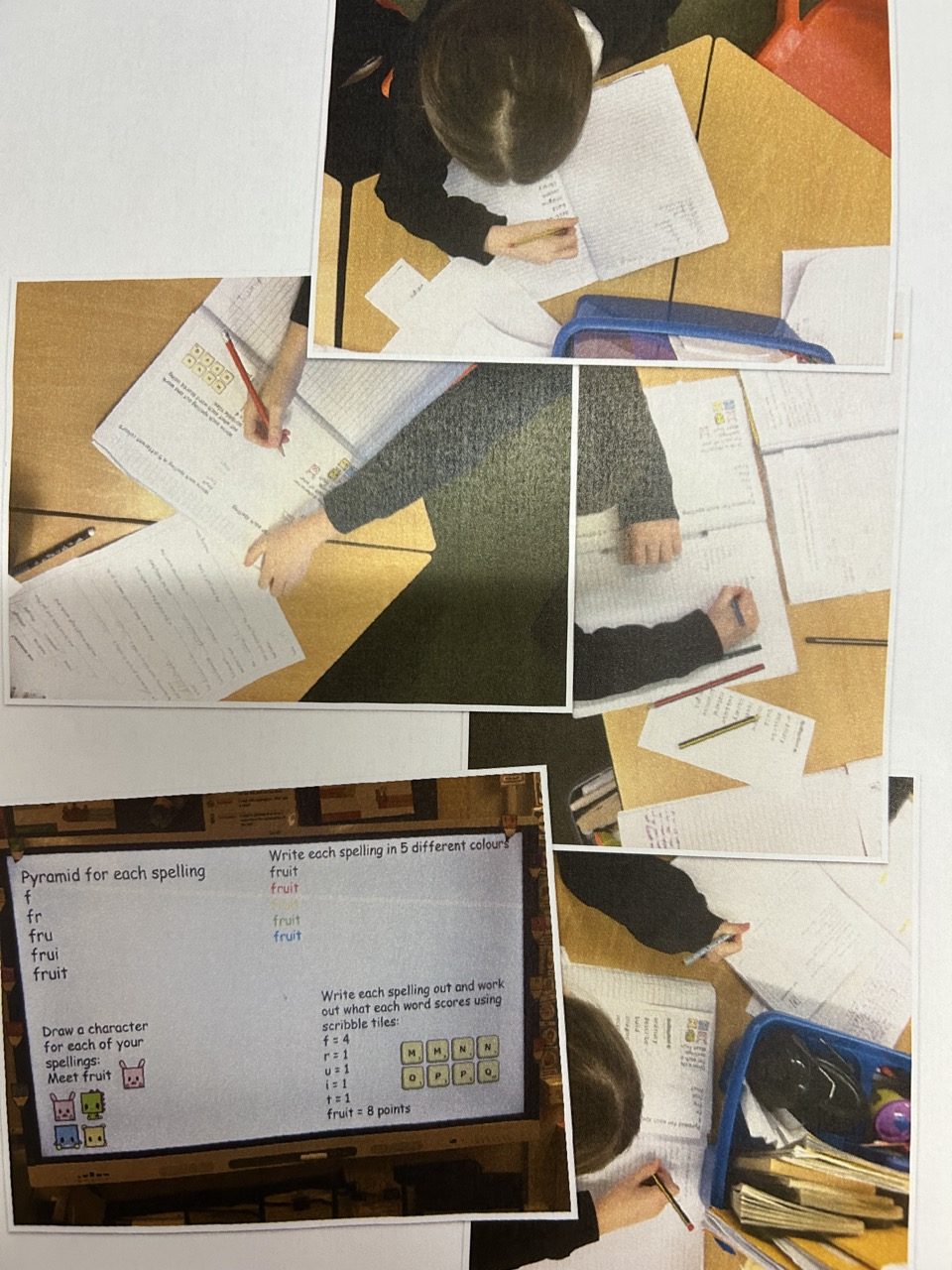
At Salhouse Primary School, the implementation of Spelling Shed across Key Stage 2 has had a positive impact on pupils’ spelling knowledge, confidence and engagement. The programme provides a structured and progressive approach to spelling, enabling pupils to develop their understanding of spelling patterns, rules and statutory vocabulary while providing regular opportunities for retrieval and application.
The use of Spelling Shed has increased the frequency and consistency of spelling practice across Key Stage 2. Pupils have regular opportunities to revisit previously taught patterns and words, helping to strengthen recall and develop increasingly secure spelling knowledge. The interactive nature of the programme encourages pupils to practise independently and has supported greater engagement with spelling activities.
Through the systematic teaching of spelling patterns, rules and vocabulary, pupils are developing a stronger understanding of phonics, morphology and word structure. This enables them to apply their knowledge to unfamiliar words rather than relying solely on memorisation.
Regular assessment and tracking through Spelling Shed enables teachers at Salhouse Primary School to identify gaps in pupils’ knowledge and provide targeted support where required. This helps teachers to respond effectively to individual needs and ensures that key spelling knowledge is revisited when necessary.
The impact of Spelling Shed is also evident in pupils’ wider written work. As pupils become more secure in their spelling, they are increasingly able to apply taught spelling patterns and vocabulary accurately within independent writing. This supports improved writing fluency, reduces the cognitive demand associated with spelling and allows pupils to focus more fully on developing their ideas and expressing themselves effectively.
Importantly, Spelling Shed has helped to develop a more positive attitude towards spelling. The engaging and interactive activities encourage pupils to take greater ownership of their learning and provide opportunities for them to practise regularly both in school and at home.
Overall, the use of Spelling Shed has strengthened the consistency, progression and assessment of spelling teaching across Key Stage 2 at Salhouse Primary School. It has supported pupils to become more confident, accurate and independent spellers, with an increasing ability to apply their spelling knowledge across their writing and the wider curriculum.
At Salhouse, we aim for our pupils to be able to think and write creatively. We give students ample time for writing to reinforce spelling skills. This includes providing them with choice in topics to increase motivation and engagement. It is essential that our pupils learn the knowledge and skills to spell accurately. We want our pupils to be equipped with the knowledge and range of strategies for learning spelling and be able to apply these when spelling words in their independent writing. We want to explicitly teach phonics, morphology, and orthography, providing opportunities for extensive writing practice, and integrating spelling with reading and other subjects to build fluency and apply knowledge in context.
Aims
- To teach spelling systematically through the school through Spelling Shed in KS2 and Read Write Inc in EYFS and KS1
- To equip children with strategies to tackle unknown words independently
- Directly teach spelling rules, word structures, and strategies, including phonics, morphology, and orthography, not just rote memorising..
- Combine spelling instruction with reading and writing. Reading can provide context and vocabulary, while writing allows for the practical application of spelling skills.
- Encourage students to be “word detectives” who can make sense of how words work, rather than simply memorising lists.
- Spelling should become automated, so students can focus on the content of their writing. This requires extensive practice and feedback to achieve fluency..
- Provide extra support for struggling learners.
- Use games and interactive activities to reinforce learning and make it enjoyable.
In Early Years and Key Stage 1, Spelling is taught daily as part of our Read Write Inc lessons. Learning spelling with Read Write Inc involves first mastering individual letter sounds, then moving to “special friends” (digraphs and trigraphs) for spelling, and finally applying these sounds through word-building and “Fred Fingers” for segmenting and spelling. The process systematically moves from reading sounds and blending them for words to segmenting words to spell them.
Step 1: Learn the individual sounds
- Children are taught the “speed sounds” in order of frequency to build a strong foundation.
- Sounds are taught with a corresponding picture prompt and phrase to help with memory (e.g., “round the apple” for the sound ‘a’).
- This stage focuses on recognizing and pronouncing sounds fluently.
Step 2: Learn “special friends” (digraphs and trigraphs)
- Once Set 1 sounds are secure, children move to Set 2 sounds, which are “special friends”.
- These are letter combinations that represent a single sound.
- Digraphs: Two letters that make one sound (e.g., ‘ay’ in “play”).
- Trigraphs: Three letters that make one sound (e.g., ‘igh’ in “light”).
- In Set 3, children learn additional spellings for sounds they already know (e.g., learning ‘ea’ as another spelling for the long ‘e’ sound they may already know as ‘ee’).
Step 3: Apply sounds for spelling
- Blending for reading: Children blend sounds to read words.
- Segmenting for spelling: Children segment words into individual sounds to spell them.
- The “Fred Fingers” technique is used for this:
- Hold up the number of fingers corresponding to the number of sounds in a word.
- Pinch a finger for each sound as it is said to segment the word.
Step 4: Practice with words and books
- Children practice spelling words by segmenting them and blending the sounds.
- They also practice reading words containing the new speed sounds.
In addition, red words involve memorising “tricky” words that cannot be sounded out phonetically. The process includes a child first learning to read them by sight during reading sessions and then practicing spelling them from memory, often through weekly “Red Word Challenge” activities. A helpful phrase for children is, “If it’s red, it’s hard for Fred,” to remind them these words need to be learned differently than phonetically decodable words. These words are included as part of the daily lesson following this format:
- Learn to read them by sight: First, children learn to recognize and read red words instantly, without “Fred-talking” them (sounding them out).
- Understand why they are tricky: These words contain phonetic elements that don’t follow the rules. For example, in the word “said,” the ‘ai’ makes an ‘e’ sound.
- Practice spelling them from memory: Once the child can read the word on sight, they can begin to practice spelling it
As children move into Key Stage 2, they will take part in regular spelling lessons using Spelling Shed. Each lesson has a main objective from the National Curriculum appendix. This may be split across multiple bullet points; each lesson has a number of components which can be taught as a single lesson per week or split into a number of sessions to be delivered over the course of a week. This is left to teacher discretion. Each week a set of words is provided, these words are examples of the spelling pattern. Each lesson contains a revision section which should last approximately 5 minutes. Children will revisit sounds and spelling patterns from earlier weeks in the scheme. The lesson sequence is planned to systematically build upon acquired knowledge. The children will practise using approaches including (but not limited to):
- Sorting words according to a given grapheme
- Syllable maps (autographic mapping)
- Segmenting words
- Sound buttons
- Alphabatise
- Cloze sentences
- Choose the correct spelling
- Morphology
- Etymology
At Salhouse, we use Literacy Tree as our scheme of work for writing. We want all children to be able to have a good understanding of English, to be able to communicate confidently in both speech and writing. We use a progressive curriculum that builds upon previous teaching, with regular assessment to ensure each child can reach their full potential. We include and engage all of our children in high quality learning experiences with the aim that they leave as confident, capable and independent writers, who not only understand the purpose and importance of writing but also enjoy the writing process.
Our aims are to:
- Plan a progressive curriculum that builds upon previous teaching, with regular assessments to ensure pupils’ individual progress within writing.
- Ensure objectives in reading and writing have purpose which are linked to high quality texts.
- Develop spoken language through debate, drama and discussion using the issues raised through, and within, text.
- Provide stimulating writing opportunities and experiences that engage and enhance all pupils.
- Teach children to write clearly, accurately and coherently, adapting their language and style for a range of contexts, purposes and audiences.
Give all children a good understanding of grammar so they can apply it to their writing.
By placing books at the core, we are allowing teachers to use the text as the context for the requirements of the national curriculum. The national curriculum states that:
‘‘This guidance is not intended to constrain or restrict teachers’ creativity, simply to provide the structure on which they can construct exciting lessons.’
This would suggest that a context for learning is vital – and this is where our chosen approach can support teachers with ensuring that objectives for reading and writing, including those for grammar can have purpose.
We will always aim for our writing opportunities to be meaningful and to feel authentic. Whether these are short or long and that the audience is clear. Books offer this opportunity: our aim would be that that children have real reasons to write, whether to explain, persuade, inform or instruct and that where possible, this can be embedded within text or linked to a curriculum area. Writing in role using a range of genres is key to our approach.
In many cases objectives are covered more than once and children have opportunities to apply these several times over the course of a year, as well as to consolidate prior knowledge from previous years. This approach supports children to think deeply and develop skills with depth.
Within each unit of work within English, children will:
- Have opportunities to participate in drama & spoken language activities.
- Explore the features of different types of texts and modelled examples.
- Use relevant strategies to widen their vocabulary including technical vocabulary.
- Experience shared and modelled writing.
- Plan, draft, edit and up-level their writing.
- Write independently and present their writing for an audience.
Perform or read their work to their peers or an audience